Secondhand Australian Fiction Bargain Book Box SP2707
Secondhand Australian Literary Fiction Bargain Book Box — 19 Books
A box that reads like a roll call of Miles Franklin Award history. Between them, the authors here have won or been shortlisted for Australia's most prestigious literary prize multiple times — Roger McDonald's The Ballad of Desmond Kale, Dal Stivens' A Horse of Air, Christopher Koch's twice-winning career, and John Scott's shortlisted The Architect among them. Add four Tom Keneally novels, three Frank Moorhouse titles, and rare fiction from Judith Wright and Peter Kocan, and this is a serious collection for any lover of Australian literature.
- The Ballad of Desmond Kale — Roger McDonald. Winner of the 2005 Miles Franklin Award. Set in the early colonial period, it follows the obsessive pursuit of a prize merino ram and the man who bred it. McDonald's prose has a richness and strangeness that makes colonial Australia feel genuinely foreign — a gripping historical novel and a deserving Miles Franklin champion.
- When Colts Ran — Roger McDonald. McDonald returns to the Australian pastoral world he knows so deeply, following two families across generations of drought, ambition, and the particular brutality of the land. Beautifully written, emotionally rich — essential for anyone who loved The Ballad of Desmond Kale.
- The Low Road — Chris Womersley. Praised by Barron Welch as "enormously powerful," this debut novel is a road story set in a fractured contemporary Australia — part crime narrative, part character study, entirely gripping. Womersley went on to write the acclaimed Bereft, and this early work shows exactly why.
- The Widow and Her Hero — Tom Keneally. A late Keneally novel in which an elderly woman looks back on her wartime marriage to a man involved in a doomed special forces operation in Singapore. It's a meditation on courage, futility, and the stories we tell ourselves about the dead — moving and morally complex.
- A River Town — Tom Keneally. Set in Kempsey, New South Wales, at the turn of the twentieth century, following an Irish immigrant storekeeper navigating the complexities of a new country. Keneally at his warmest and most generous — vivid, humane, and deeply grounded in Australian experience.
- The Coca-Cola Kid — Frank Moorhouse. Selected stories from one of Australia's great satirists and experimenters, whose work dissected Australian manners, sexual politics, and national identity with wit and precision. This collects some of his most celebrated shorter fiction.
- Room Service — Frank Moorhouse. More connected stories from Moorhouse — the hotel, the conference, the anonymous city — exploring the transient, displaced, modern Australian life that was his great subject. Sharp, funny, and unexpectedly touching.
- Conference-Ville — Frank Moorhouse. The third Moorhouse title in this box, and a natural companion to Room Service: the world of international conferences, bureaucratic farce, and the odd intimacies that form in temporary spaces. Nobody did this world better.
- A Horse of Air — Dal Stivens. Winner of the Miles Franklin Award, and one of Australian fiction's more distinctive voices — Stivens blended realism with surrealism and folk tale in ways that feel entirely his own. A Horse of Air is his masterpiece: the story of a man's obsession, told with dark wit and genuine strangeness.
- The Architect — John Scott. Shortlisted for the Miles Franklin Award, this is one of Australian fiction's more radical and demanding novels — formally innovative, unsettling, and deeply engaged with questions of history, violence, and representation. Not for the faint-hearted; essential for serious readers.
- A Private Man — Malcolm Knox. Knox is both a celebrated novelist and one of Australia's finest sports journalists, and A Private Man brings those worlds together: a study of a man whose private life is radically at odds with his public face. Sharp, morally serious, and compulsively readable.
- Season in Purgatory — Thomas Keneally. A wartime novel from early in Keneally's career, set among Partisan fighters in Yugoslavia — full of the moral intensity and historical sweep that would later give the world Schindler's Ark. Keneally at his most urgent.
- An Angel in Australia — Tom Keneally. Set in wartime Sydney, following a young Catholic priest navigating faith, desire, and the upheaval of a city at war. Keneally drew on his own seminary experience to give this novel an authenticity and interiority that sets it apart.
- Bluebird — Malcolm Knox. A novel of Australian beach culture, adolescence, and the long shadows that early experience casts. Knox writes the Australian summer — surf, sun, mates, threat — with insider authority and literary ambition. A book that deserves far more readers than it found.
- The Memory Room — Christopher Koch. From the twice Miles Franklin-winning author of The Year of Living Dangerously, this late novel is a spy story set between Cold War Canberra and Southeast Asia — atmospheric, intelligent, and haunted by secrecy and betrayal. Koch is one of the greats of Australian fiction.
- The Treatment and the Cure — Peter Kocan. The second volume of Kocan's autobiographical trilogy about his years in a psychiatric institution, following The Flea Circus. Written with extraordinary restraint and clarity, it is one of the most quietly devastating accounts of institutionalisation in Australian literature.
- An Accommodating Spouse — Elizabeth Jolley. Late Jolley, and characteristically strange: the story of a widower who makes an unusual bargain with a woman who will keep house for him. Jolley's fiction is always quietly subversive, laced with dark humour, and shot through with longing — this is no exception.
- The Nature of Love — Judith Wright. Judith Wright is best known as one of Australia's greatest poets, but she also wrote fiction — and this rare prose collection is a genuine find for anyone interested in the full range of her work. Lyrical, attentive to landscape, and carrying the moral depth of all her writing.
- Players — Tony Wilson. A comic novel of Australian media and politics, full of sharp observation and the kind of satirical energy that makes you laugh and wince simultaneously. Wilson brings genuine insider knowledge to a very recognisable world.
Original: $57.29
-65%$57.29
$20.05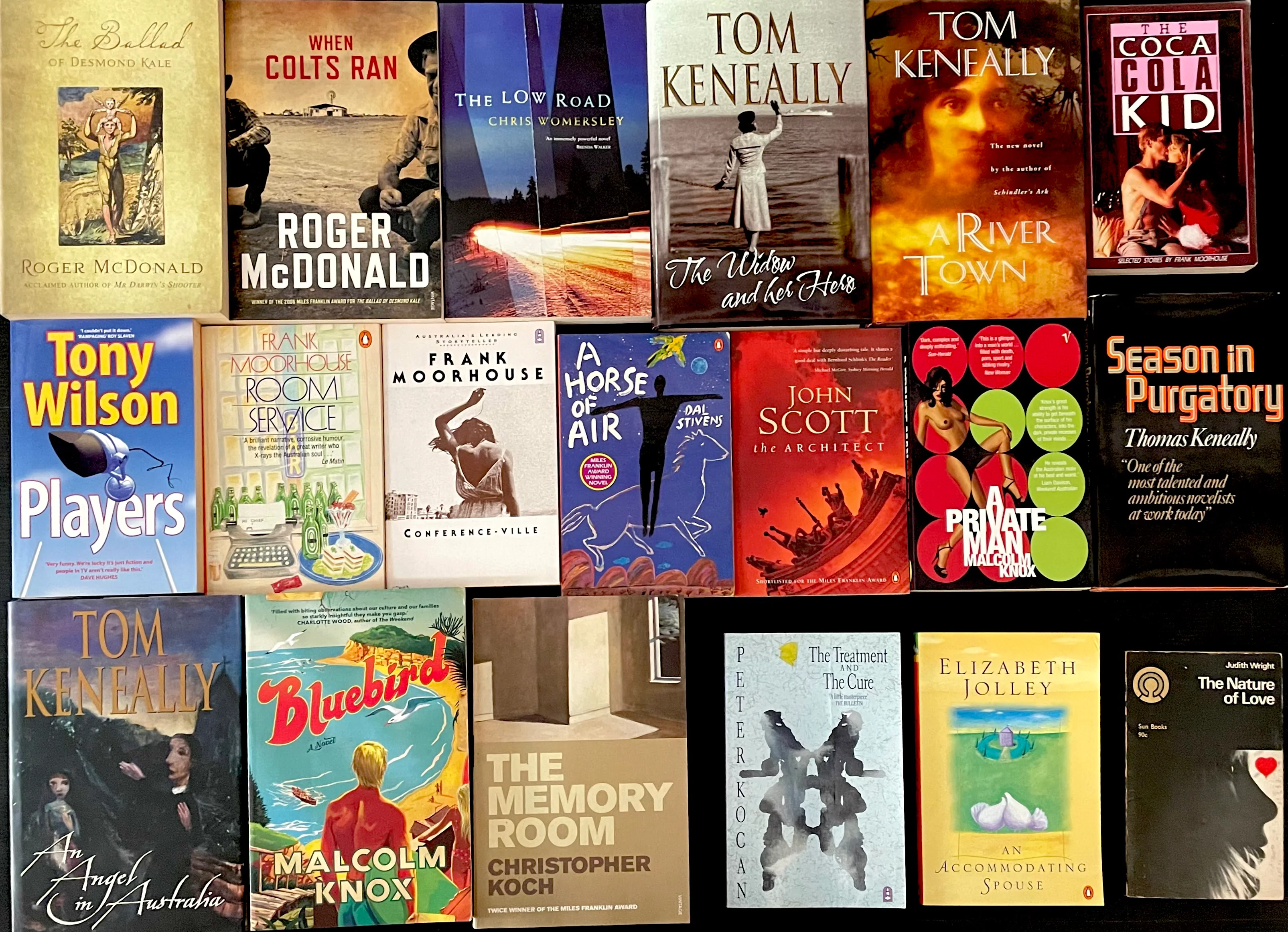
Description
Secondhand Australian Literary Fiction Bargain Book Box — 19 Books
A box that reads like a roll call of Miles Franklin Award history. Between them, the authors here have won or been shortlisted for Australia's most prestigious literary prize multiple times — Roger McDonald's The Ballad of Desmond Kale, Dal Stivens' A Horse of Air, Christopher Koch's twice-winning career, and John Scott's shortlisted The Architect among them. Add four Tom Keneally novels, three Frank Moorhouse titles, and rare fiction from Judith Wright and Peter Kocan, and this is a serious collection for any lover of Australian literature.
- The Ballad of Desmond Kale — Roger McDonald. Winner of the 2005 Miles Franklin Award. Set in the early colonial period, it follows the obsessive pursuit of a prize merino ram and the man who bred it. McDonald's prose has a richness and strangeness that makes colonial Australia feel genuinely foreign — a gripping historical novel and a deserving Miles Franklin champion.
- When Colts Ran — Roger McDonald. McDonald returns to the Australian pastoral world he knows so deeply, following two families across generations of drought, ambition, and the particular brutality of the land. Beautifully written, emotionally rich — essential for anyone who loved The Ballad of Desmond Kale.
- The Low Road — Chris Womersley. Praised by Barron Welch as "enormously powerful," this debut novel is a road story set in a fractured contemporary Australia — part crime narrative, part character study, entirely gripping. Womersley went on to write the acclaimed Bereft, and this early work shows exactly why.
- The Widow and Her Hero — Tom Keneally. A late Keneally novel in which an elderly woman looks back on her wartime marriage to a man involved in a doomed special forces operation in Singapore. It's a meditation on courage, futility, and the stories we tell ourselves about the dead — moving and morally complex.
- A River Town — Tom Keneally. Set in Kempsey, New South Wales, at the turn of the twentieth century, following an Irish immigrant storekeeper navigating the complexities of a new country. Keneally at his warmest and most generous — vivid, humane, and deeply grounded in Australian experience.
- The Coca-Cola Kid — Frank Moorhouse. Selected stories from one of Australia's great satirists and experimenters, whose work dissected Australian manners, sexual politics, and national identity with wit and precision. This collects some of his most celebrated shorter fiction.
- Room Service — Frank Moorhouse. More connected stories from Moorhouse — the hotel, the conference, the anonymous city — exploring the transient, displaced, modern Australian life that was his great subject. Sharp, funny, and unexpectedly touching.
- Conference-Ville — Frank Moorhouse. The third Moorhouse title in this box, and a natural companion to Room Service: the world of international conferences, bureaucratic farce, and the odd intimacies that form in temporary spaces. Nobody did this world better.
- A Horse of Air — Dal Stivens. Winner of the Miles Franklin Award, and one of Australian fiction's more distinctive voices — Stivens blended realism with surrealism and folk tale in ways that feel entirely his own. A Horse of Air is his masterpiece: the story of a man's obsession, told with dark wit and genuine strangeness.
- The Architect — John Scott. Shortlisted for the Miles Franklin Award, this is one of Australian fiction's more radical and demanding novels — formally innovative, unsettling, and deeply engaged with questions of history, violence, and representation. Not for the faint-hearted; essential for serious readers.
- A Private Man — Malcolm Knox. Knox is both a celebrated novelist and one of Australia's finest sports journalists, and A Private Man brings those worlds together: a study of a man whose private life is radically at odds with his public face. Sharp, morally serious, and compulsively readable.
- Season in Purgatory — Thomas Keneally. A wartime novel from early in Keneally's career, set among Partisan fighters in Yugoslavia — full of the moral intensity and historical sweep that would later give the world Schindler's Ark. Keneally at his most urgent.
- An Angel in Australia — Tom Keneally. Set in wartime Sydney, following a young Catholic priest navigating faith, desire, and the upheaval of a city at war. Keneally drew on his own seminary experience to give this novel an authenticity and interiority that sets it apart.
- Bluebird — Malcolm Knox. A novel of Australian beach culture, adolescence, and the long shadows that early experience casts. Knox writes the Australian summer — surf, sun, mates, threat — with insider authority and literary ambition. A book that deserves far more readers than it found.
- The Memory Room — Christopher Koch. From the twice Miles Franklin-winning author of The Year of Living Dangerously, this late novel is a spy story set between Cold War Canberra and Southeast Asia — atmospheric, intelligent, and haunted by secrecy and betrayal. Koch is one of the greats of Australian fiction.
- The Treatment and the Cure — Peter Kocan. The second volume of Kocan's autobiographical trilogy about his years in a psychiatric institution, following The Flea Circus. Written with extraordinary restraint and clarity, it is one of the most quietly devastating accounts of institutionalisation in Australian literature.
- An Accommodating Spouse — Elizabeth Jolley. Late Jolley, and characteristically strange: the story of a widower who makes an unusual bargain with a woman who will keep house for him. Jolley's fiction is always quietly subversive, laced with dark humour, and shot through with longing — this is no exception.
- The Nature of Love — Judith Wright. Judith Wright is best known as one of Australia's greatest poets, but she also wrote fiction — and this rare prose collection is a genuine find for anyone interested in the full range of her work. Lyrical, attentive to landscape, and carrying the moral depth of all her writing.
- Players — Tony Wilson. A comic novel of Australian media and politics, full of sharp observation and the kind of satirical energy that makes you laugh and wince simultaneously. Wilson brings genuine insider knowledge to a very recognisable world.